
Table of Contents
- Why Breathing Exercises Work for Anxiety
- How to Calm Anxiety Quickly With Deep Breathing
- Box Breathing for Anxiety: Step-by-Step
- The 4-7-8 Breathing Technique Explained
- Breathing Exercises for Panic Attacks
- Three More Techniques: Alternate Nostril, Equal Breathing, and Pursed-Lip
- Building a Practice Plan That Sticks
- When to Combine Breathing Exercises With Professional Support
- Frequently Asked Questions
Last Updated: October 11, 2026
Why Breathing Exercises Work for Anxiety
Anxiety activates your nervous system’s fight-or-flight response, causing your heart to race, muscles to tense, and breathing to become shallow and rapid.
Breathing exercises interrupt this cycle. When you slow your breathing intentionally, you signal safety to your nervous system. Your body shifts into a calmer state, which quiets anxious thoughts.
These techniques require no equipment, app, or special setting.
At Randall Meadows Psychotherapy, I help clients build these tools as part of a solution-oriented approach to managing anxiety.
How to Calm Anxiety Quickly With Deep Breathing
Deep breathing, also called diaphragmatic breathing or belly breathing, is the foundation of most anxiety-relief techniques.
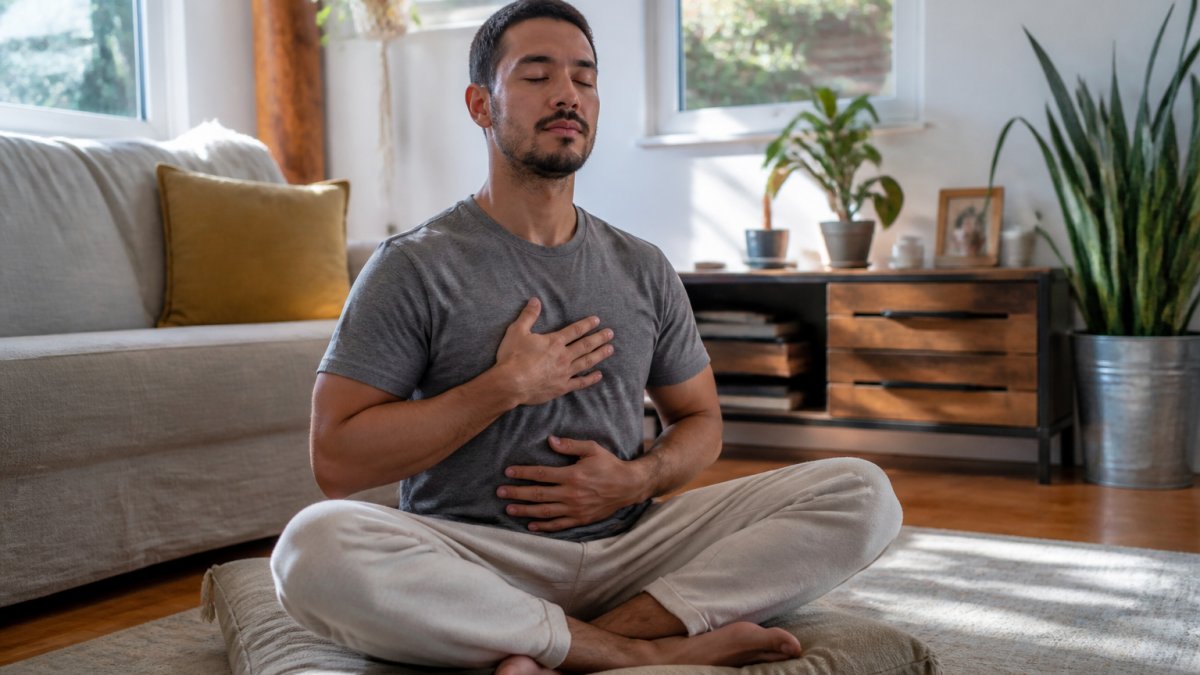
Most people breathe shallowly, which increases anxiety. Deep breathing reverses this by activating your parasympathetic nervous system, responsible for relaxation (Effects of Diaphragmatic Breathing on Health: A Narrative Review).
Here’s how to practice deep breathing:
- Sit or lie in a comfortable position
- Place one hand on your chest and one on your belly
- Breathe in slowly through your nose for a count of four
- Hold the breath for a count of four
- Exhale slowly through your mouth for a count of four
- Pause for a count of four before the next breath
- Repeat for 5-10 minutes
The goal is to feel your belly rise and fall, not your chest. Your chest hand should stay mostly still.
Practice this breathing exercise for anxiety daily, even when you’re not anxious, to build the skill for when you need it. Five minutes each morning makes breathing exercises for anxiety more effective during stressful moments.
Box Breathing for Anxiety: Step-by-Step
Box breathing, also called square breathing, is a structured technique used by military personnel and athletes (Box breathing or six breaths per minute). It’s ideal for people who struggle with open-ended breathing exercises.
The technique follows a simple pattern: inhale, hold, exhale, hold, each for the same count, creating a “box” of equal sides.
Step-by-step guide:
- Exhale completely
- Inhale through your nose for a count of four
- Hold your breath for a count of four
- Exhale through your mouth for a count of four
- Hold empty for a count of four
- Repeat 5-10 times
Box breathing’s equal counts create a meditative quality that calms racing thoughts and feels more grounding than free-form deep breathing.
Start with a count of four; adjust to five, six, or three based on comfort. Your comfort matters more than hitting a specific number.
The 4-7-8 Breathing Technique Explained
The 4-7-8 breathing technique shifts your nervous system toward relaxation. It’s more challenging than box breathing but often more powerful.
The pattern is simple: inhale for four counts, hold for seven, exhale for eight. The extended exhale activates your parasympathetic nervous system more effectively than a longer inhale.
How to practice the 4-7-8 breathing technique:
- Exhale completely through your mouth
- Close your mouth and inhale through your nose for a count of four
- Hold your breath for a count of seven
- Exhale through your mouth for a count of eight
- Repeat four to eight times
The 4-7-8 breathing technique works well before bed or during high anxiety. Some people feel results after one round; others need several cycles.
If holds feel uncomfortable, reduce counts proportionally (try 3-5-6 or 2-4-6). The ratio matters more than absolute numbers.
Breathing Exercises for Panic Attacks
Why standard techniques may not work during panic:
Box breathing and the 4-7-8 technique require sustained counting and breath holds.
The extended-exhale approach for acute panic:
During a panic attack, focus on one simple variable: make your exhale longer than your inhale.
- Notice your natural breathing rhythm without trying to change it
- Gradually extend your exhale to be twice as long as your inhale
- If you naturally inhale for two counts, exhale for four
- If you naturally inhale for three counts, exhale for six
- Breathe this way for 2-3 minutes
A prolonged exhale directly activates your parasympathetic nervous system without requiring mental effort or breath holds.
What to do if breathing feels uncomfortable during panic:
Some people experience increased anxiety or dizziness when focusing on breath during panic. This signals that breath-focused attention is triggering in that moment.
If this happens:
- Stop the breathing exercise. Use the 5-4-3-2-1 grounding technique: name five things you can see, four you can touch, three you can hear, two you can smell, one you can taste.
- Move your body. Walk, stretch, or change position to interrupt the panic cycle.
- Use a shorter timeframe. Try 30 seconds of extended exhale, then pause and reassess.
- Practice during calm moments first. Practice the extended-exhale technique daily when calm so it feels familiar during panic.
Realistic expectations:
Breathing exercises can reduce panic intensity or duration but may not stop it completely on the first attempt.
Three More Techniques: Alternate Nostril, Equal Breathing, and Pursed-Lip
Three additional breathing exercises offer variety and targeted benefits for different situations and nervous-system states.
Alternate Nostril Breathing
Alternate nostril breathing (nadi shodhana in yoga tradition) balances nervous system activation by breathing through one nostril at a time in an alternating pattern, creating a rhythmic, meditative state.
How to practice:
- Sit comfortably with your spine upright
- Use your right hand: close your right nostril with your right thumb
- Inhale through your left nostril for a count of four
- Close your left nostril with your ring finger, release your right nostril
- Exhale through your right nostril for a count of four
- Inhale through your right nostril for four
- Close your right nostril, release your left
- Exhale through your left nostril for four
- Continue alternating for 5-10 minutes
When to use it:
Alternate nostril breathing helps when you feel scattered, mentally foggy, or caught between competing emotions. It’s useful in the afternoon when clarity drops. Because it requires hand positioning, use it at home or in a private space.
Accessibility note:
If hand positioning is uncomfortable, practice without hand placement: simply focus on breathing through one nostril, then the other. Mental focus provides most of the benefit.
Equal Breathing
Equal breathing (sama vritti in Sanskrit) uses the same count for inhale and exhale with no holds, creating balance and steadiness without the intensity of box breathing or the 4-7-8 technique.
How to practice:
- Sit or lie comfortably
- Inhale through your nose for a count of four
- Exhale through your nose for a count of four
- Continue for 5-10 minutes
You can adjust the count based on your comfort: three counts, five counts, or six counts all work equally well. The key is that inhale and exhale are the same length.
When to use it:
Equal breathing is gentler than box breathing and excellent for beginners. Use it for midday stress (2-3 minutes at your desk), transition moments between tasks, evening wind-down, or discreet public use (bus, waiting room, conversation pause).
Pursed-Lip Breathing
Pursed-lip breathing extends your exhale by creating gentle resistance as air passes through your lips, amplifying the calming effect of a long exhale.
How to practice:
- Breathe in normally through your nose (no special count needed)
- Purse your lips as if you’re about to whistle or blow out a candle
- Exhale slowly through your pursed lips, making the exhale twice as long as your inhale
- If you inhaled for two counts, exhale for four
- Repeat for 5-10 minutes
When to use it:
Pursed-lip breathing is effective during acute anxiety because it requires minimal mental effort and no counting.
Choosing among the three:
If you feel scattered or foggy → Alternate nostril breathing
If you need a gentle, all-day technique → Equal breathing
If you’re in acute anxiety and need simplicity → Pursed-lip breathing
Many people find that rotating among these three techniques prevents boredom and keeps their practice fresh.
Building a Practice Plan That Sticks
Knowing breathing exercises for anxiety is one thing; using them consistently is another. Most people abandon techniques if they don’t feel immediate relief.
Effective practice requires a plan:
|
Phase |
Duration |
Practice |
Goal |
|---|---|---|---|
|
Foundation |
Week 1-2 |
Daily deep breathing, 5 minutes |
Build basic skill |
|
Expansion |
Week 3-4 |
Try two techniques, 5-10 minutes each |
Find your preference |
|
Deepening |
Week 5-8 |
Daily practice with preferred technique |
Build automaticity |
|
Integration |
Ongoing |
Use during low-stress moments first |
Make it accessible |
Start with deep breathing daily at the same time (morning works well). After two weeks, try box breathing or the 4-7-8 technique and notice which feels more natural.
Once you have a preferred technique, practice it during calm moments, waiting in line, work breaks, or before bed, to build the neural pathway for when anxiety strikes.
When to Combine Breathing Exercises With Professional Support
Breathing exercises for anxiety work best for situational anxiety, pre-presentation stress, social nervousness, or early panic stages, but they have limits.
For chronic, severe, or life-interfering anxiety, breathing exercises alone won’t resolve it. They’re a helpful addition to professional therapy, not a replacement.
Professional support addresses root causes: why your nervous system stays activated, what thoughts fuel worry, and what patterns maintain anxiety.
If breathing exercises help temporarily but don’t resolve your anxiety, professional support would be valuable. Combining breathing techniques with therapy accelerates progress.
Anxiety responds to the right tools and support. When ready to go deeper, professional support helps you address underlying patterns and build greater ease and clarity. Contact Randall Meadows to explore how solution-oriented therapy can complement your breathing practice.
Frequently Asked Questions
What is the best breathing exercise for anxiety?
The best breathing exercise depends on your situation and preference. Box breathing and the 4-7-8 technique are widely used for anxiety because they activate your parasympathetic nervous system, which calms your body. Deep diaphragmatic breathing (belly breathing) works well for everyday anxiety, while alternate nostril breathing suits those who prefer a gentler approach. Start with one technique and practice it consistently for at least one week before deciding if it works for you.
How long should you do breathing exercises for anxiety?
Most breathing exercises for anxiety work best when practiced for 5 to 10 minutes per session. You can start with just 2 to 3 minutes if that feels manageable. The key is consistency: practicing daily, even for a short time, produces better results than sporadic longer sessions. Many people find that doing a breathing exercise twice daily—morning and evening—helps them manage baseline anxiety levels throughout the day.
Can breathing exercises help with panic attacks?
Yes. Breathing exercises for panic attacks work by slowing your breathing rate and signaling to your nervous system that you are safe. Box breathing and pursed-lip breathing are especially effective during a panic attack because they give your mind a concrete focus and interrupt the panic cycle. The key is to practice these techniques when you are calm so you can access them automatically when panic strikes. If panic attacks are frequent or severe, combining breathing exercises with professional therapy provides the most effective support.
What should I do if holding my breath feels uncomfortable?
If breath holds in techniques like box breathing or 4-7-8 breathing feel uncomfortable, start with shorter counts. Instead of holding for 4 counts, try 2 counts. You can gradually increase the hold time as your comfort grows. Pursed-lip breathing and equal breathing do not require breath holds, so they are good alternatives if holding your breath triggers anxiety. Always breathe through your nose when possible, and stop immediately if you feel dizzy or lightheaded.
Recent Comments